What it looks like
An impressive achievement.
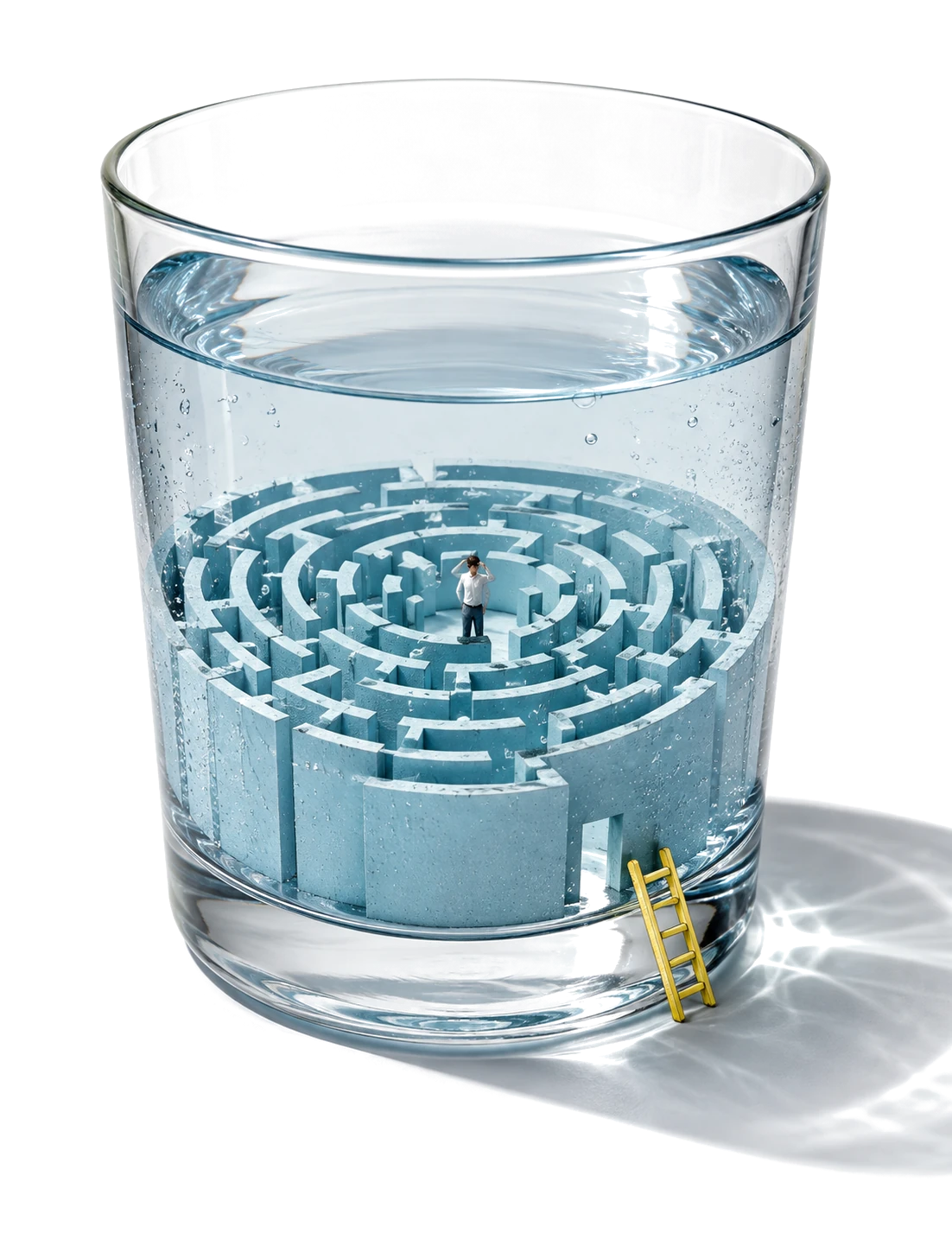
Getting lost usually requires a forest, an unfamiliar city or at least a road with no signs.
Here, a glass of water will do.
A few centimetres across.
An exit practically everywhere.
And yet, somehow, we managed it.
What it really is
It is the talent for turning a tiny difficulty into a problem much bigger than it actually is.
Not because there is no solution. Quite the opposite: the solution is often sitting there in plain sight.
But first we need to consider every possible alternative, imagine everything that could go wrong, ask for someone’s opinion, change our mind, return to the original idea and, if possible, involve a person who until that moment did not even know there was a problem.
By then, the glass has become an ocean.
The scene
— Did you book the restaurant?
— No, because first we need to know what time they’re arriving.
— They’re arriving at eight.
— Yes, but they might be late.
— Then book it for eight thirty.
— Right, but what if they’re on time?
— Book it for eight.
— But then we have to park.
— There’s a car park right outside.
— Yes, but what if it’s full?
Pause.
— You know what? Let’s just eat at home.
The key
The problem is not the glass. It is everything we manage to put inside it.
Perdersi in un bicchier d’acqua — literally, “to get lost in a glass of water” — is used when someone gets stuck on something simple by multiplying doubts, steps and complications until the obvious solution disappears from view.
It is usually ironic, often affectionate and occasionally exasperated.
From the outside, the way out is perfectly obvious.
From inside, apparently, rather less so.