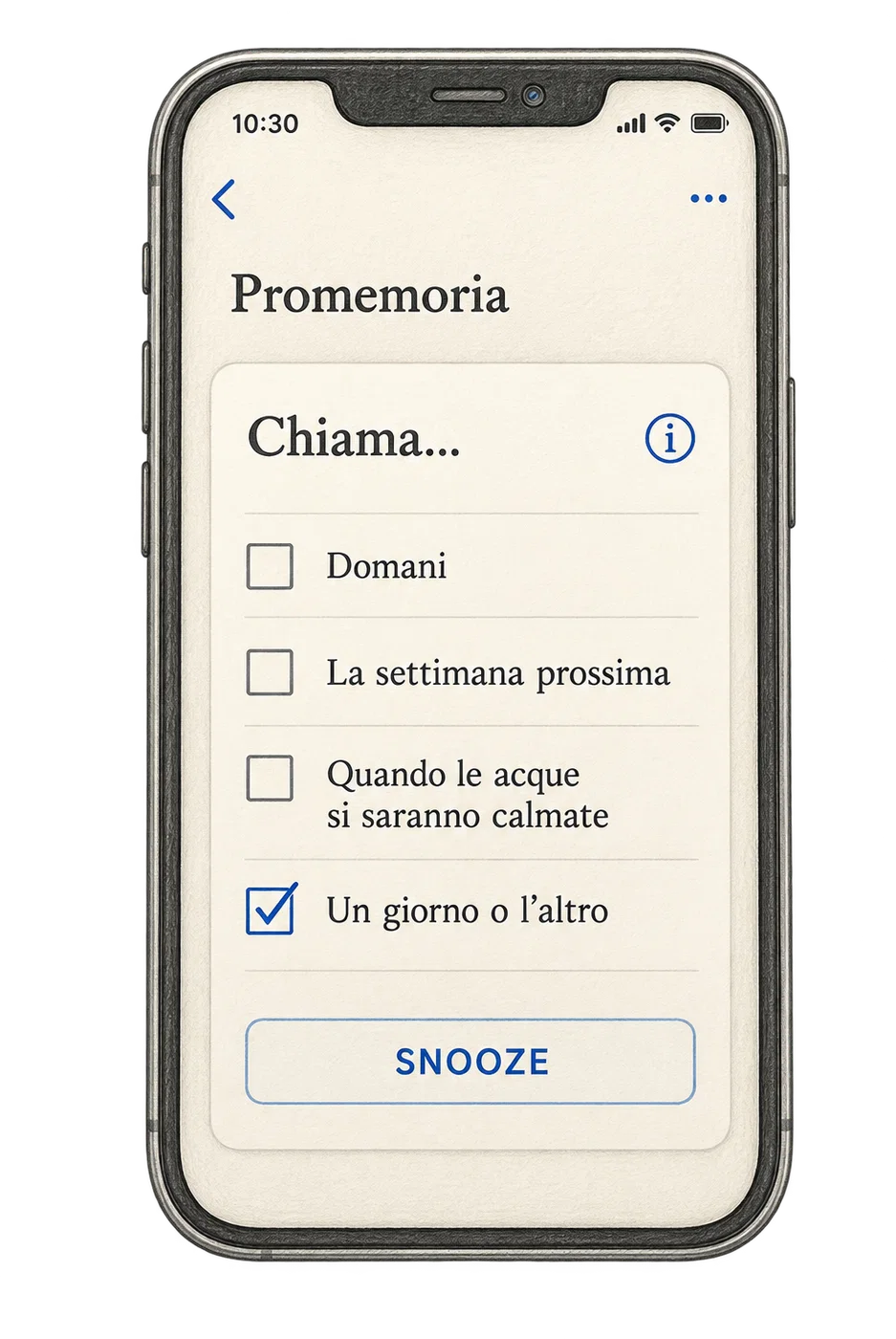
What it seems to be
A promise to speak again soon.
What it really is
If an Italian ends a conversation with ci sentiamo, do not rush to check your phone.
They might call tomorrow.
Or next month.
Or never.
And, remarkably, in all three cases the phrase remains perfectly correct.
To a foreigner it can sound like a promise. After all, the implied verb points to the future: we will speak again.
To an Italian, however, it is much more often a farewell formula. An elegant way of avoiding turning the end of a conversation into a definitive closure.
Because simply saying ciao can almost feel too abrupt.
Ci sentiamo leaves a possibility open.
It does not say when.
It does not say how.
It does not say who has to make the first move.
It merely says that, if our paths happen to cross again one day, neither of us will feel that something was left unresolved.
The curious thing is that both people know the rules of the game.
When two acquaintances say goodbye with a warm ci sentiamo!, often neither genuinely expects the phone to ring.
And if months or years pass, nobody thinks the other has broken a promise.
Because the promise was never really the point.
The point was to leave the relationship on good terms.
Italians do not like closing doors.
They prefer to leave them ajar.
Scene
— È stato un piacere rivederti.
— Anche per me.
— Allora ci sentiamo.
— Certo, ci sentiamo.
Four years pass.
One day they meet by chance at the airport.
— Oh, guarda chi si vede! Come stai?
Nobody feels the need to say:
“Sorry, I never called you.”
The key to understanding it
For Italians, ci sentiamo is not the description of a future appointment. It is a gentle way to keep a goodbye from sounding like a farewell.