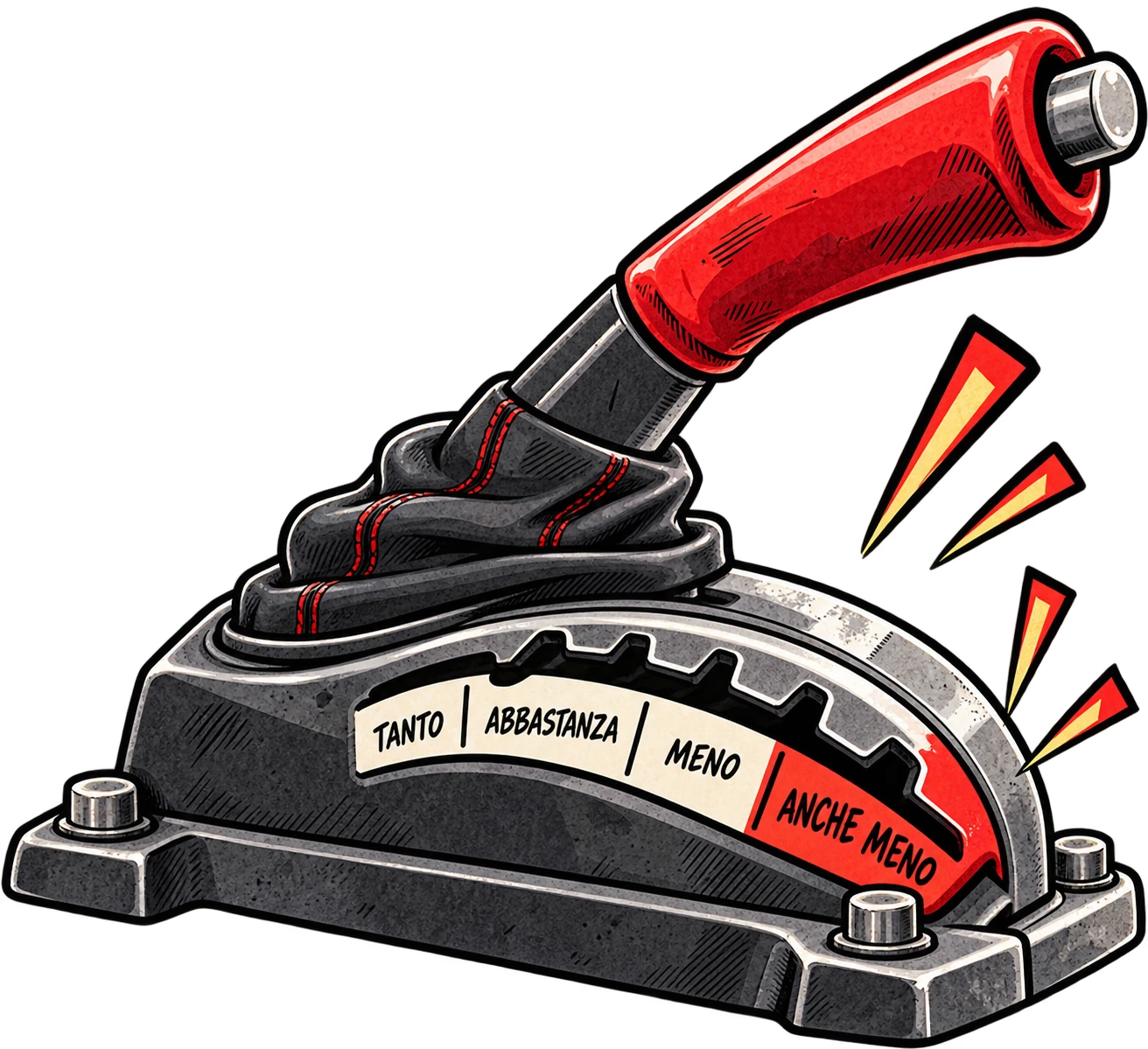
What it looks like
A thank-you. An unusually enthusiastic one.
What it really is
Italians say “grazie al cazzo” when someone has just delivered information that is perfectly correct and spectacularly obvious.
“If you leave earlier, you arrive earlier.” Grazie al cazzo. You are not expressing gratitude. You are reviewing the informational value of the sentence.
The elegant part is that you completely agree. That is precisely the problem.
The scene
A BED Talk. Red stage, black blazer, solemn audience. After eighteen minutes of storytelling and three meaningful pauses, the speaker reveals: “To get results, you have to do things.”
Applause. Someone nods as if Socrates has returned. You think: grazie al cazzo.
Some motivational talks have a rare gift: taking something your grandmother would say while draining pasta and returning it with red lights, white sneakers and a standing ovation.
Freud, forgive us
Italian has a small anatomical obsession. Cazzo can mean nothing, something worthless, absolutely not, mind your own business, annoyance, incompetence and several other things depending on the preposition and volume.
Freud may take a seat, but we do not need to diagnose a nation. It is enough to notice that Italian has turned one body part into an adverb, adjective, negation, unit of measure and critical instrument.
How to read it
“Grazie al cazzo” measures the distance between how solemnly something is announced and how useful it actually is. The more a banality is presented as revelation, the stronger it becomes.
It is popular fact-checking for obviousness: it does not prove a statement false. It proves something worse — that saying it added nothing. We needed this entire entry to explain that. Grazie al cazzo.