What it looks like
An explanation.
A fairly elaborate one, too.
There are words, subordinate clauses, technical references and a certain confidence in the delivery. The speaker seems to know exactly where he is going.
The listener, rather less so.
What it really means
Absolutely nothing.
And that is precisely the difficult part.
A supercazzola is not simply saying random things. That would be too easy. It is building a completely meaningless argument while giving it all the outward signs of a meaningful one.
You need rhythm. Conviction. Above all, you must never stop.
Because the exact moment you stop, somebody might ask a question.
And then you are in trouble.
How it works
The supercazzola officially comes from cinema, although it probably existed in Italy for centuries before that.
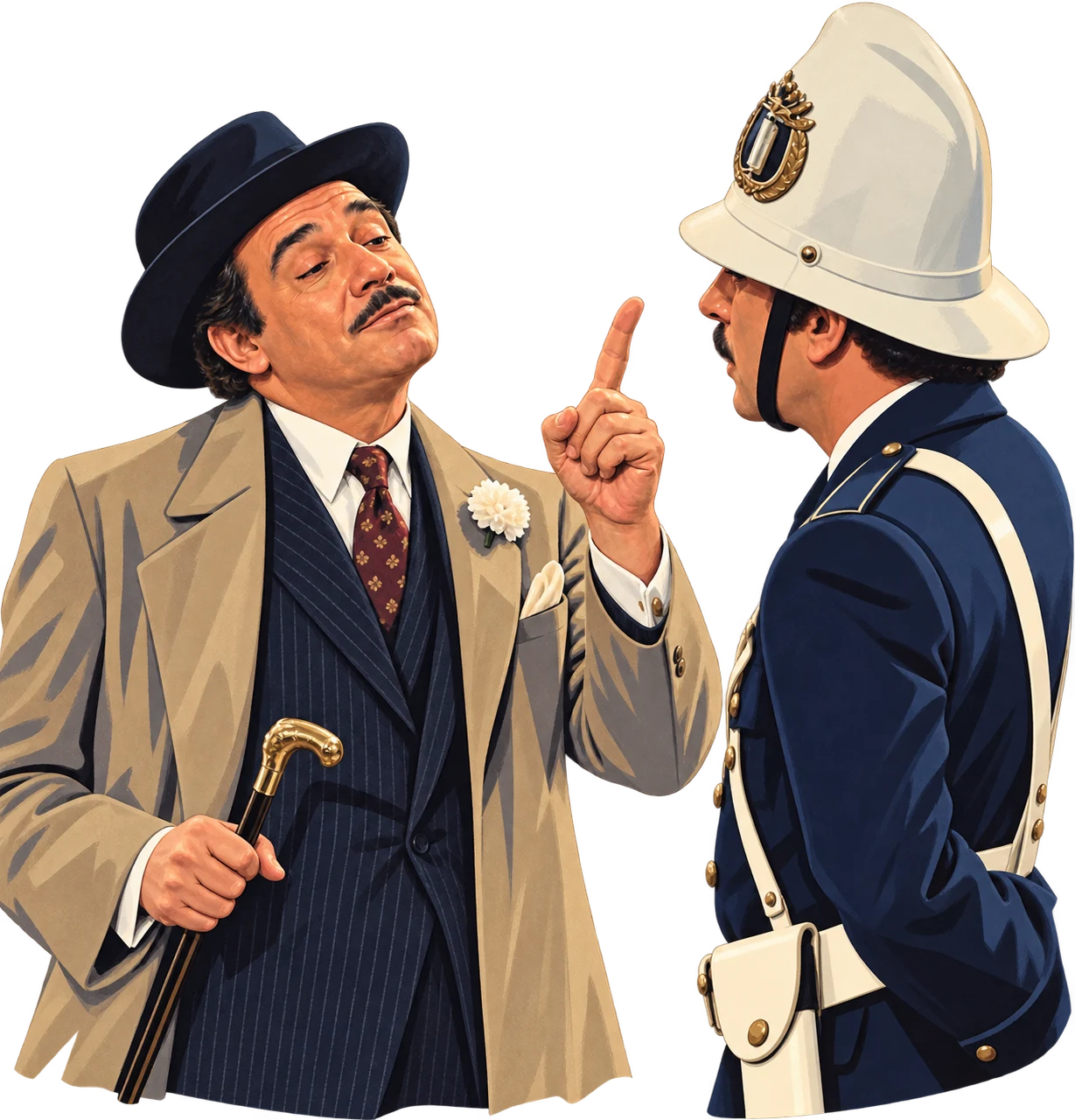
In Amici miei, Count Raffaello Mascetti — Ugo Tognazzi — turns it into an art form: plausible words, apparently impeccable syntax, invented terms and sudden semantic accelerations are fired at the listener with such authority that a small miracle occurs.
For a few seconds, the person saying nothing appears to know everything.
And the person who does not understand starts wondering whether the problem is theirs.
That is the masterpiece.
The victim does not say, “This makes no sense.” They think, “Wait. Maybe I missed something.”
By then it is already too late.
A minimal survival guide
If an Italian starts giving you an explanation you cannot understand, do not panic.
It might be the language. It might be bureaucracy. It might genuinely be a very complicated subject.
Or it might be a supercazzola.
A useful clue is the disproportion between the speaker’s confidence and the amount of actual information you can extract.
The more the first rises while the second approaches zero, the more likely the diagnosis.
Be careful: asking for clarification can make things worse. A properly executed supercazzola can explain the previous supercazzola with an even larger supercazzola.
The key to understanding it
Today Italians use supercazzola well beyond Amici miei.
A meeting full of words that decides nothing. A very long answer that carefully avoids the question. An eighteen-slide presentation explaining a concept that does not exist. An expert who adds complicated terminology exactly when things should become clearer.
“He gave me a supercazzola.”
Roughly: he spoke well enough to make me forget that he had told me nothing.
That may be why the word survived the film so successfully.
Mascetti was a character. The supercazzola is still all around us.
Cultural note
This entry is also a small bow to Ugo Tognazzi and Amici miei.
Some characters leave us a line.
Mascetti left us something far more dangerous: a method.